Christ Lutheran Church
Luther's Small Catechism
The core teachings of the Christian faith as explained in Luther's Small Catechism

Luther's Small Catechism
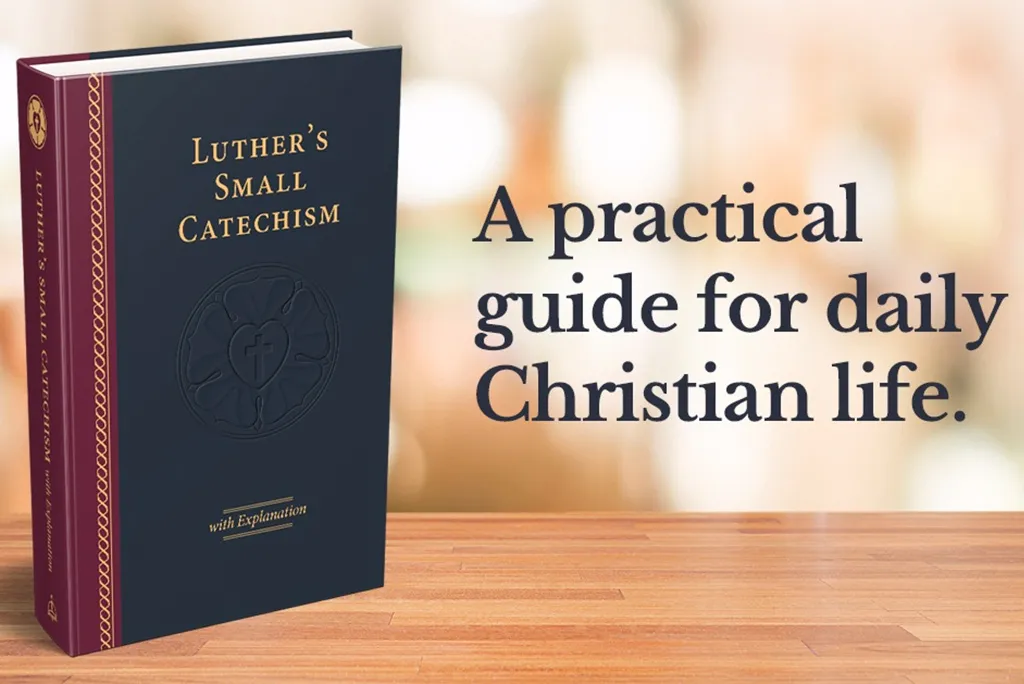
Christians of every age benefit from learning and praying the Small Catechism. If you would like a copy, visit Concordia Publishing House (CPH) or speak with our pastor about instruction and preparation for the Lord’s Supper.

Introduction
Luther's Small Catechism, first published in 1529, was written by Dr. Martin Luther to help teach the basics of the Christian faith. The Small Catechism presents the central teachings of Scripture in a simple question-and-answer format that is easy to understand and memorize.
Purpose and Use
The Small Catechism serves several important purposes:
Provides a clear summary of Christian doctrine
Helps parents teach their children the faith
Prepares people for receiving the Lord's Supper
Guides pastors in teaching and examining catechumens
Structure
The Small Catechism is organized into the following parts:
Each section follows a simple pattern of stating the teaching, asking "What does this mean?", and providing a clear explanation supported by Scripture.
The Ten Commandments
The First Commandment
Thou shalt have no other gods.
What does this mean?
We should fear, love, and trust in God above all things.
The Second Commandment
Thou shalt not take the name of the Lord, thy God, in vain.
What does this mean?
We should fear and love God that we may not curse, swear, use witchcraft, lie, or deceive by His name, but call upon it in every trouble, pray, praise, and give thanks.
The Third Commandment
Thou shalt sanctify the holy-day.
What does this mean?
We should fear and love God that we may not despise preaching and His Word, but hold it sacred, and gladly hear and learn it.
The Fourth Commandment
Thou shalt honor thy father and thy mother [that it may be well with thee and thou mayest live long upon the earth].
What does this mean?
We should fear and love God that we may not despise nor anger our parents and masters, but give them honor, serve, obey, and hold them in love and esteem.
The Fifth Commandment
Thou shalt not kill.
What does this mean?
We should fear and love God that we may not hurt nor harm our neighbor in his body, but help and befriend him in every bodily need [in every need and danger of life and body].
The Sixth Commandment
Thou shalt not commit adultery.
What does this mean?
We should fear and love God that we may lead a chaste and decent life in words and deeds, and each love and honor his spouse.
The Seventh Commandment
Thou shalt not steal.
What does this mean?
We should fear and love God that we may not take our neighbor’s money or property, nor get them by false ware or dealing, but help him to improve and protect his property and business [that his means are preserved and his condition is improved].
The Eighth Commandment
Thou shalt not bear false witness against thy neighbor.
What does this mean?
We should fear and love God that we may not deceitfully belie, betray, slander, or defame our neighbor, but defend him, [think and] speak well of him, and put the best construction on everything.
The Nineth Commandment
Thou shalt not covet thy neighbor's house.
What does this mean?
We should fear and love God that we may not craftily seek to get our neighbor’s inheritance or house, and obtain it by a show of [justice and] right, etc., but help and be of service to him in keeping it.
The Tenth Commandment
Thou shalt not covet thy neighbor's wife, nor his man-servant, nor his cattle, nor anything that is his.
What does this mean?
We should fear and love God that we may not estrange, force, or entice away our neighbor’s wife, servants, or cattle, but urge them to stay and [diligently] do their duty.
Conclusion
What Does God Say of All These Commandments?
Answer. He says thus (Exod. 20:5f): I the Lord, thy God, am a jealous God, visiting the iniquity of the fathers upon the children unto the third and fourth generation of them that hate Me, and showing mercy unto thousands of them that love Me and keep My commandments.
What does this mean?
God threatens to punish all that transgress these commandments. Therefore we should dread His wrath and not act contrary to these commandments. But He promises grace and every blessing to all that keep these commandments. Therefore we should also love and trust in Him, and gladly do [zealously and diligently order our whole life] according to His commandments.
The Apostles' Creed
The First Article: Of Creation
I believe in God the Father Almighty, Maker of heaven and earth.
What does this mean?
I believe that God has made me and all creatures; that He has given me my body and soul, eyes, ears, and all my limbs, my reason, and all my senses, and still preserves them; in addition thereto, clothing and shoes, meat and drink, house and homestead, wife and children, fields, cattle, and all my goods; that He provides me richly and daily with all that I need to support this body and life, protects me from all danger, and guards me and preserves me from all evil; and all this out of pure, fatherly, divine goodness and mercy, without any merit or worthiness in me; for all which I owe it to Him to thank, praise, serve, and obey Him. This is most certainly true.
The Second Article: Of Redemption
And in Jesus Christ, His only Son, our Lord; who was conceived by the Holy Ghost, born of the Virgin Mary; suffered under Pontius Pilate, was crucified, dead, and buried; He descended into hell; the third day He rose again from the dead; He ascended into heaven, and sitteth on the right hand of God the Father Almighty; from thence He shall come to judge the quick and the dead.
What does this mean?
I believe that Jesus Christ, true God, begotten of the Father from eternity, and also true man, born of the Virgin Mary, is my Lord, who has redeemed me, a lost and condemned creature, purchased and won [delivered] me from all sins, from death, and from the power of the devil, not with gold or silver, but with His holy, precious blood and with His innocent suffering and death, in order that I may be [wholly] His own, and live under Him in His kingdom, and serve Him in everlasting righteousness, innocence, and blessedness, even as He is risen from the dead, lives and reigns to all eternity. This is most certainly true.
The Third Article: Of Sanctification
I believe in the Holy Ghost; one holy Christian Church, the communion of saints; the forgiveness of sins; the resurrection of the body; and the life everlasting. Amen.
What does this mean?
I believe that I cannot by my own reason or strength believe in Jesus Christ, my Lord, or come to Him; but the Holy Ghost has called me by the Gospel, enlightened me with His gifts, sanctified and kept me in the true faith; even as He calls, gathers, enlightens, and sanctifies the whole Christian Church on earth, and keeps it with Jesus Christ in the one true faith; in which Christian Church He forgives daily and richly all sins to me and all believers, and at the last day will raise up me and all the dead, and will give to me and to all believers in Christ everlasting life. This is most certainly true.
The Lord's Prayer
As the head of the family should teach it in a simple way to his household.
Introduction
Our Father who art in heaven.
What does this mean?
God would thereby [with this little introduction] tenderly urge us to believe that He is our true Father, and that we are His true children, so that we may ask Him confidently with all assurance, as dear children ask their dear father.
The First Petition
Hallowed be Thy name.
What does this mean?
God’s name is indeed holy in itself; but we pray in this petition that it may become holy among us also.
How is this done?
When the Word of God is taught in its truth and purity, and we as the children of God also lead holy lives in accordance with it. To this end help us, dear Father in heaven. But he that teaches and lives otherwise than God’s Word teaches profanes the name of God among us. From this preserve us, Heavenly Father.
The Second Petition
Thy kingdom come.
What does this mean?
The kingdom of God comes indeed without our prayer, of itself; but we pray in this petition that it may come unto us also.
How is this done?
When our heavenly Father gives us His Holy Spirit, so that by His grace we believe His holy Word and lead a godly life here in time and yonder in eternity.
The Third Petition
Thy will be done on earth as it is in heaven.
What does this mean?
The good and gracious will of God is done indeed without our prayer; but we pray in this petition that it may be done among us also.
How is this done?
When God breaks and hinders every evil counsel and will which would not let us hallow the name of God nor let His kingdom come, such as the will of the devil, the world, and our flesh; but strengthens and keeps us steadfast in His Word and in faith unto our end. This is His gracious and good will.
The Fourth Petition
Give us this day our daily bread.
What does this mean?
God gives daily bread, even without our prayer, to all wicked men; but we pray in this petition that He would lead us to know it, and to receive our daily bread with thanksgiving.
What is meant by daily bread?
Everything that belongs to the support and wants of the body, such as meat, drink, clothing, shoes, house, homestead, field, cattle, money, goods, a pious spouse, pious children, pious servants, pious and faithful magistrates, good government, good weather, peace, health, discipline, honor, good friends, faithful neighbors, and the like.
The Fifth Petition
And forgive us our trespasses, as we forgive those who trespass against us.
What does this mean?
God gives daily bread, even without our prayer, to all wicked men; but we pray in this petition that He would lead us to know it, and to receive our daily bread with thanksgiving.
What idoes this mean
We pray in this petition that our Father in heaven would not look upon our sins, nor deny such petitions on account of them; for we are worthy of none of the things for which we pray, neither have we deserved them; but that He would grant them all to us by grace; for we daily sin much, and indeed deserve nothing but punishment. So will we verily, on our part, also heartily forgive and also readily do good to those who sin against us.
The Sixth Petition
And lead us not into temptation.
What does this mean?
God, indeed, tempts no one; but we pray in this petition that God would guard and keep us, so that the devil, the world, and our flesh may not deceive us, nor seduce us into misbelief, despair, and other great shame and vice; and though we be assailed by them, that still we may finally overcome and gain the victory.
The Seventh Petition
But deliver us from evil.
What does this mean?
We pray in this petition, as in a summary, that our Father in heaven would deliver us from all manner of evil, of body and soul, property and honor, and at last, when our last hour shall come, grant us a blessed end, and graciously take us from this vale of tears to Himself into heaven.
The Conclusion
For Thine is the kingdom, and the power, and the glory, forever and ever. Amen.
What does this mean?
We pray in this petition, as in a summary, that our Father in heaven would deliver us from all manner of evil, of body and soul, property and honor, and at last, when our last hour shall come, grant us a blessed end, and graciously take us from this vale of tears to Himself into heaven.
The Sacrament of Holy Baptism
As the head of the family should teach it in a simple way to his household.
First - The Nature of Baptism
What is Baptism?
Baptism is not simple water only, but it is the water comprehended in God’s command and connected with God’s Word.
Which is that word of God?
Christ, our Lord, says in the last chapter of Matthew: Go ye into all the world and teach all nations, baptizing them in the name of the Father, and of the Son, and of the Holy Ghost.
Second - The Blessing of Baptism
What does Baptism give or profit?
It works forgiveness of sins, delivers from death and the devil, and gives eternal salvation to all who believe this, as the words and promises of God declare.
Which are such words and promises of God?
Christ, our Lord, says in the last chapter of Mark: He that believeth and is baptized shall be saved; but he that believeth not shall be damned.
Third - The Power of Baptism
How can water do such great things?
It is not the water indeed that does them, but the word of God which is in and with the water, and faith, which trusts such word of God in the water. For without the word of God the water is simple water and no baptism. But with the word of God it is a baptism, that is, a gracious water of life and a washing of regeneration in the Holy Ghost, as St. Paul says, Titus, chapter three: By the washing of regeneration and renewing of the Holy Ghost, which He shed on us abundantly through Jesus Christ, our Savior, that, being justified by His grace, we should be made heirs according to the hope of eternal life. This is a faithful saying.
Fourth - The Meaning of Baptism
What does such baptizing with water signify?
It signifies that the old Adam in us should, by daily contrition and repentance, be drowned and die with all sins and evil lusts, and, again, a new man daily come forth and arise; who shall live before God in righteousness and purity forever.
Where is this written?
St. Paul says Romans 6:4: We are buried with Christ by Baptism into death, that, like as He was raised up from the dead by the glory of the Father, even so we also should walk in newness of life.
The Office of the Keys and Confession
What is the Office of the Keys?
The Office of the Keys is the special authority which Christ has given to His Church on earth: to forgive the sins of the penitent sinners, but to retain the sins of the impenitent as long as they do not repent.
Where is this written?
The evangelist writes, John 20:22-23: “Jesus breathed on His disciples and said to them, ‘Receive the Holy Spirit. If you forgive the sins of any, they are forgiven them; and if you retain the sins of any, they are retained.’”
What is Confession?
Confession consists of two parts: one, that we confess our sins; the other, that we receive absolution, or forgiveness, from the pastor or confessor as from God himself, and in no way doubt, but firmly believe that our sins are thereby forgiven before God in heaven.
What sins should we confess?
Before God we should acknowledge ourselves guilty of all sins, even of those which we do not know about, as we do in the Lord’s Prayer. But before the pastor or confessor we should acknowledge those sins only which we know and feel in our hearts.
Which are these?
Here consider your own situation according to the Ten Commandments, whether you are a father, mother, son, daughter, employer, employee; whether you have been disobedient, dishonest, lazy; whether you have injured anyone by word or deed; whether you have stolen, neglected, wasted anything, or done any harm.
The Sacrament of the Altar
As the head of the family should teach it in a simple way to his household.
First - The Nature of the Sacrament of the Altar
What is the Sacrament of the Altar?
The Sacrament of the Altar is the true body and blood of our Lord Jesus Christ, under the bread and wine, instituted by Christ himself, for us Christians to eat and to drink.
Where is that written?
The holy evangelists Matthew, Mark, Luke, together with St. Paul, write thus: “Our Lord Jesus Christ, the same night in which He was betrayed, took bread; and when He had given thanks, He broke it and gave it to His disciples, saying, ‘Take, eat; this is My body, which is given for you. Do this in remembrance of Me.’ In the same way also He took the cup after supper, gave thanks and gave it to them, saying, ‘Drink from it all of you; this cup is the New Testament in My blood, which is shed for you for the remission of sins. Do this, as often as you drink it, in remembrance of Me.’”
Second - The Benefit of the Sacrament of the Altar
What benefit do we receive from such eating and drinking?
The benefit which we receive from such eating and drinking is shown us by these words: “Given and shed for you for the remission of sins,” namely, that in the Sacrament forgiveness of sins, life and salvation are given us through these words. For where there is forgiveness of sins, there is also life and salvation.
Which are such words and promises of God?
Christ, our Lord, says in the last chapter of Mark: He that believeth and is baptized shall be saved; but he that believeth not shall be damned.
Third - The Power of the Sacrament of the Altar
How can bodily eating and drinking do such great things?
It is not the eating and drinking that does this, but the words here written, “Given and shed for you for the remission of sins.” These words, along with the eating and drinking, are the main thing in the Sacrament; and whoever believes these words has exactly what they say, namely, the forgiveness of sins.
Fourth - THE PROPER RECEPTION OF THE SACRAMENT OF THE ALTAR
Who then receives this Sacrament worthily?
Fasting and bodily preparation are indeed a fine outward training; but he is truly worthy and well prepared who has faith in these words, “Given and shed for you for the remission of sins.” But he who does not believe these words, or doubts them, is unworthy and unprepared; for the words “for you” require truly believing hearts.
Daily Prayers
How the head of the family should teach his household to pray morning and evening.
Morning Prayer
In the morning, when you rise, you shall bless yourself with the holy cross and say: In the name of God the Father, Son, and Holy Ghost. Amen.
Then, kneeling or standing, repeat the Creed and the Lord’s Prayer. If you choose, you may, in addition, say this little prayer: I thank Thee, my Heavenly Father, through Jesus Christ, Thy dear Son, that Thou hast kept me this night from all harm and danger; and I pray Thee to keep me this day also from sin and all evil, that all my doings and life may please Thee. For into Thy hands I commend myself, my body and soul, and all things. Let Thy holy angel be with me, that the Wicked Foe may have no power over me. Amen.
Then go to your work with joy, singing a hymn, as the Ten Commandments, or what your devotion may suggest.
Evening Prayer
In the evening, when you go to bed, you shall bless yourself with the holy cross and say: In the name of God the Father, Son, and Holy Ghost. Amen.
Then, kneeling or standing, repeat the Creed and the Lord’s Prayer. If you choose, you may, in addition, say this little prayer: I thank Thee, my Heavenly Father, through Jesus Christ, Thy dear Son, that Thou hast graciously kept me this day, and I pray Thee to forgive me all my sins, where I have done wrong, and graciously keep me this night. For into Thy hands I commend myself, my body and soul, and all things. Let Thy holy angel be with me, that the Wicked Foe may have no power over me. Amen. Then go to sleep promptly and cheerfully.
Prayer Before Eating
The eyes of all wait upon You, O Lord, and You give them their food in due season; You open Your hand and satisfy the desire of every living thing. Lord God, heavenly Father, bless us and these Your gifts which we receive from Your bountiful goodness, through Jesus Christ, our Lord. Amen.
Prayer After Eating
Oh, give thanks to the Lord, for he is good, for His mercy endures forever. We thank You, Lord God, heavenly Father, through Jesus Christ, our Lord, for all Your benefits, You who live and reign forever and ever. Amen.
Table of Duties
Certain passages of scripture for various holy orders and positions, admonishing them about their duties and responsibilities.
A bishop must be blameless, the husband of one wife, vigilant, sober, of good behavior, given to hospitality, apt to teach; not given to wine, no striker, not greedy of filthy lucre; but patient, not a brawler, not covetous; one that ruleth well his own house, having his children in subjection with all gravity; not a novice; holding fast the faithful Word as he hath been taught, that he may be able by sound doctrine both to exhort and to convince the gainsayers. 1 Tim. 3:2ff ; Titus 1:6.
What the Hearers Owe to Their Pastors.
Even so hath the Lord ordained that they which preach the Gospel should live of the Gospel. 1 Cor. 9:14. Let him that is taught in the Word communicate unto him that teacheth in all good things. Gal. 6:6. Let the elders that rule well be counted worthy of double honor, especially they who labor in the Word and doctrine. For the Scripture saith, Thou shalt not muzzle the ox that treadeth out the corn; and the laborer is worthy of his reward. 1 Tim. 5:17-18. Obey them that have the rule over you, and submit yourselves; for they watch for your souls as they that must give account, that they may do it with joy and not with grief; for that is unprofitable for you. Heb. 13:17.
Concerning Civil Government.
Let every soul be subject unto the higher powers. For the power which exists anywhere is ordained of God. Whosoever resisteth the power resisteth the ordinance of God; and they that resist shall receive to themselves damnation. For he beareth not the sword in vain; for he is the minister of God, a revenger to execute wrath upon him that doeth evil. Rom. 13:1-4.
What Subjects Owe to the Magistrates.
Render unto Caesar the things which are Caesar’s. Matt. 22:21. Let every soul be subject unto the higher powers, etc. Wherefore ye must needs be subject, not only for wrath, but also for conscience’ sake. For, for this cause pay ye tribute also; for they are God’s ministers, attending continually upon this very thing. Render therefore to all their dues: tribute to whom tribute is due; custom, to whom custom; fear, to whom fear; honor, to whom honor. Rom. 13:1,5ff. I exhort, therefore, that, first of all, supplications, prayers, intercessions, and giving of thanks be made for all men; for kings and for all that are in authority, that we may lead a quiet and peaceable life in all godliness and honesty. 1 Tim. 2:1f Put them in mind to be subject to principalities and powers, etc. Titus 3:1. Submit yourselves to every ordinance of man for the Lord’s sake, whether it be to the king as supreme, or unto governors as unto them that are sent by him, etc. 1 Pet. 2:13f ]
For Husbands.
Ye husbands, dwell with your wives according to knowledge, giving honor unto the wife, as unto the weaker vessel, and as being heirs together of the grace of life, that your prayers be not hindered. 1 Pet. 3:7. And be not bitter against them. Col. 3:9.
For Wives.
Wives, submit yourselves unto your own husbands, as unto the Lord, even as Sarah obeyed Abraham, calling him lord; whose daughters ye are, as long as ye do well, and are not afraid with any amazement. 1 Pet. 3:6; Eph. 5:22.
For Parents.
Ye fathers, provoke not your children to wrath, but bring them up in the nurture and admonition of the Lord. Eph. 6:4.
For Children.
Children, obey your parents in the Lord; for this is right. Honor thy father and mother; which is the first commandment with promise: that it may be well with thee, and thou mayest live long on the earth. Eph. 6:1-3.
For Male and Female Servants, Hired Men, and Laborers.
Servants, be obedient to them that are your masters according to the flesh, with fear and trembling, in singleness of your heart, as unto Christ; not with eye-service, as men-pleasers, but as the servants of Christ, doing the will of God from the heart; with good will doing service as to the Lord, and not to men; knowing that whatsoever good thing any man doeth, the same shall he receive of the Lord, whether he be bond or free. Eph. 6:5ff ; Col. 3:22.
For Masters and Mistresses.
For Young Persons in General.
Likewise, ye younger, submit yourselves unto the elder. Yea, all of you be subject one to another, and be clothed with humility; for God resisteth the proud, and giveth grace to the humble. Humble yourselves, therefore, under the mighty hand of God that He may exalt you in due time. 1 Pet. 5:5-6.
For Widows.
She that is a widow indeed, and desolate, trusteth in God, and continueth in supplications and prayers night and day. But she that liveth in pleasure is dead while she liveth. 1 Tim. 5:5-6.
For All in Common.
Thou shalt love thy neighbor as thyself. Herein are comprehended all the commandments. Rom. 13:8ff And persevere in prayer for all men. 1 Tim. 2:1-2.
Let each his lesson learn with care, And all the household well shall fare.
Cuique sit imprimis magnae sua lectio curae, Ut domus officiis stet decorata suis.
Πας ιδιην αναγνωσιν εης πραπιδεσσιν αθρησας, Οιχον εχει πυχινων ευπορεοντα χαλων
Christian Questions and Answers
Prepared by Dr. Martin Luther for those who intend to go to the Sacrament
[The “Christian Questions with Their Answers,” designating Luther as the author, first appeared in an edition of the Small Catechism in 1551, five years after Luther’s death]. After confession and instruction in the Ten Commandments, the Creed, the Lord’s Prayer, and the Sacraments of Baptism and the Lord’s Supper, the pastor may ask, or Christians may ask themselves these questions:
1. Do you believe that you are a sinner?
Yes, I believe it. I am a sinner.
2. How do you know this?
From the Ten Commandments, which I have not kept.
3. Are you sorry for your sins?
Yes, I am sorry that I have sinned against God.
4. What have you deserved from God because of your sins?
His wrath and displeasure, temporal death, and eternal damnation. See Romans 6:21, Romans 6:23.
5. Do you hope to be saved?
Yes, that is my hope,
6. In whom then do you trust?
In my dear Lord Jesus Christ.
7. Who is Christ?
The Son of God, true God and man.
8. How many Gods are there?
Only one, but there are three persons: Father, Son, and Holy Spirit.
9. What has Christ done for you that you trust in Him?
He died for me and shed His blood for me on the cross for the forgiveness of sins.
10. Did the Father also die for you?
He did not. The Father is God only, as is the Holy Spirit; but the Son is both true God and true man. He died for me and shed his blood for me.
11. How do you know this?
From the holy Gospel, from the words instituting the Sacrament, and by His body and blood given me as a pledge in the Sacrament.
12. What are the Words of Institution?
Our Lord Jesus Christ, on the night when He was betrayed, took bread and when He had given thanks, He broke it and gave it to the disciples and said: “Take eat; this is My body, which is given for you. This do in remembrance of Me.” In the same way also He took the cup after supper, and when He had given thanks, He gave it to them, saying: “Drink of it, all of you; this cup is the new testament in My blood, which is shed for you for the forgiveness of sins. This do, as often as you drink it, in remembrance of Me.”
13. Do you believe, then, that the true body and blood of Christ are in the Sacrament?
Yes, I believe it.
14. What convinces you to believe this?
The word of Christ: Take, eat, this is My body; drink of it, all of you, this is My blood.
15. What should we do when we eat His body and drink His blood, and in this way receive His pledge?
We should remember and proclaim His death and the shedding of His blood, as He taught us: This do, as often as you drink it, in remembrance of Me.
16. Why should we remember and proclaim His death?
First, so that we may learn to believe that no creature could make satisfaction for our sins. Only Christ, true God and man, could do that. Second, so we may learn to be horrified by our sins, and to regard them as very serious. Third, so we may find joy and comfort in Christ alone, and through faith in Him be saved.
17. What motivated Christ to die and make full payment for your sins?
His great love for His Father and for me and other sinners, as it is written in John 14; Romans 5; Galatians 2 and Ephesians 5.
18. Finally, why do you wish to go to the Sacrament?
That I may learn to believe that Christ, out of great love, died for my sin, and also learn from Him to love God and my neighbor.
19. What should admonish and encourage a Christian to receive the Sacrament frequently?
First, both the command and the promise of Christ the Lord. Second, his own pressing need, because of which the command, encouragement, and promise are given.
20. But what should you do if you are not aware of this need and have no hunger and thirst for the Sacrament?
To such a person no better advice can be given than this: first, he should touch his body to see if he still has flesh and blood. Then he should believe what the Scriptures say of it in Galatians 5 and Romans 7. Second, he should look around to see whether he is still in the world, and remember that there will be no lack of sin and trouble, as the Scriptures say in John 15-16 and in 1 John 2 and 5. Third, he will certainly have the devil also around him, who with his lying and murdering day and night will let him have no peace, within or without, as the Scriptures picture him in John 8 and 16; 1 Peter 5; Ephesians 6; and 2 Timothy 2.
Note:
These questions and answers are no child’s play, but are drawn up with great earnestness of purpose by the venerable and devout Dr. Luther for both young and old. Let each one pay attention and consider it a serious matter; for St. Paul writes to the Galatians in chapter six: “Do not be deceived: God cannot be mocked.
Next Steps
Purchase a copy of Luther's Small Catechism from Concordia Publishing House (CPH) →
Learn the basics of faith with our Lutheran Resources →
Talk with the pastor about instruction: Contact / Find Us →
New to Lutheranism? Start here: New to Lutheranism →


Worship &
BIBLE Study

Sunday School: 9:30 AM
Divine Service: 11:00 AM
Wednesday Bible Study: 6:00 PM
Christ Lutheran Church - Wathena KS
Lutheran Church - Missouri Synod (LCMS)